
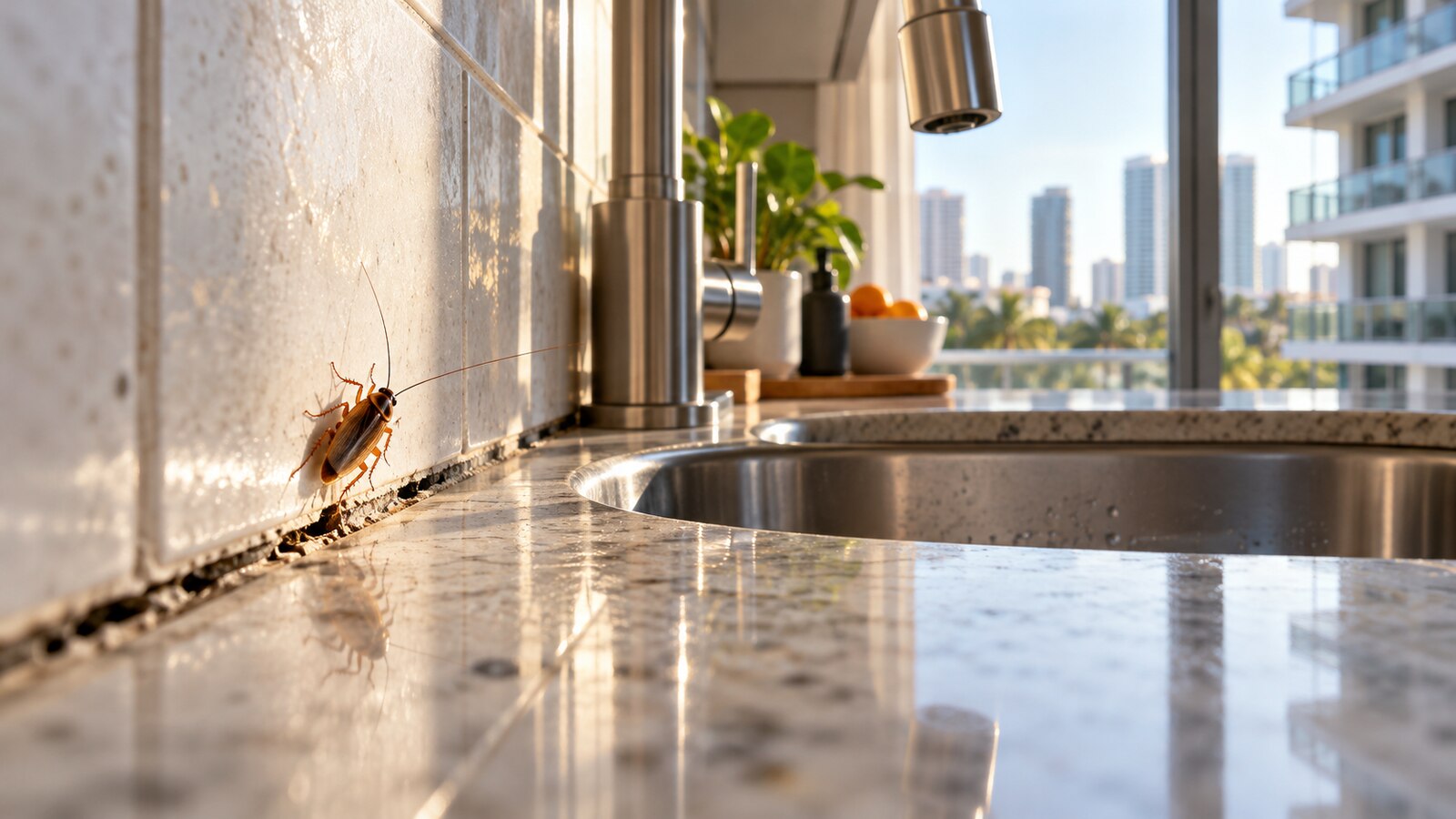
Why do cockroaches keep appearing even after an apartment has been cleaned or treated?
New research involving the University of Florida suggests that persistent cockroach infestations in multi-family housing are often more complicated than individual housekeeping practices.
For Miami apartment residents, condominium owners, and property managers, the findings offer valuable insight into why coordinated pest management is so important.
What the 2026 Cockroach Research Found
In July 2026, researchers from the University of Florida, University of Kentucky, and Louisiana State University highlighted findings from a national study involving 926 renters.
The research examined the challenges of controlling cockroaches in multi-family residential buildings.
Among surveyed renters who had experienced cockroach problems:
- More than 70% reported seeing cockroaches at least once a month.
- Nearly 30% reported daily sightings.
- Many expressed satisfaction with pest control efforts despite continuing cockroach activity.
The survey included participants from multiple states and should not be interpreted as a measurement of cockroach prevalence specifically in Miami.
Why Cockroaches Can Spread Between Apartments
In multi-unit buildings, neighboring residences often share structural spaces.
These may include:
- Plumbing penetrations
- Utility connections
- Wall cavities
- Ventilation openings
- Gaps around cabinets and appliances
Such conditions may allow cockroaches to move between units or access concealed areas.
This means treating one apartment may not fully address a recurring problem when neighboring spaces continue to support pest activity.
Why German Cockroaches Are Especially Challenging
German cockroaches are among the most common indoor cockroach species.
They can reproduce rapidly and hide in narrow spaces near food, moisture, and warmth.
Common areas where activity may develop include kitchens, bathrooms, utility closets, and spaces around appliances.
Signs of a possible infestation include repeated sightings, egg cases, droppings, and activity in multiple rooms.
A single sighting does not determine the size of an infestation, but recurring activity should be investigated.
What Miami Apartment Residents Can Do
Residents can support effective cockroach management through several practical measures:
Report Activity Early
Notify property management when cockroaches appear, particularly when activity continues after treatment.
Reduce Food and Moisture Sources
Keep food in sealed containers, remove accumulated food residue, and repair leaking pipes.
Limit Hiding Places
Reduce unnecessary cardboard storage and clutter where cockroaches may shelter.
Avoid Uncoordinated Treatments
Repeatedly applying consumer insecticides without understanding the infestation can complicate a coordinated pest management program.
Document Recurring Problems
Record sightings, affected rooms, and dates to help professionals identify patterns.
Why Property Managers Need a Coordinated Approach
When multiple apartments are affected, property managers may need to evaluate shared areas, utility spaces, maintenance conditions, and neighboring units.
An effective management program may combine:
- Detailed inspections
- Pest monitoring
- Moisture management
- Sanitation improvements
- Structural exclusion
- Targeted treatment
The objective is to address both visible pest activity and the conditions that allow infestations to continue.
Cockroach Control in Miami Requires More Than a Quick Treatment
Every building presents different challenges.
A professional inspection can help determine whether a cockroach problem is isolated or connected to broader building conditions.
At Ronin Pest Control Miami, we focus on understanding pest activity and identifying practical control options for each property.
Dealing with recurring cockroach activity in your Miami apartment or condominium?
Contact Ronin Pest Control Miami to request a scheduled assessment.
Call (786) 808-8506.
Source
University of Florida Institute of Food and Agricultural Sciences (UF/IFAS), July 6, 2026: National survey on persistent cockroach infestations in multi-family residential buildings.